

How to Avoid Capital Gains Tax on Stocks in Canada and the United States

Updated: Jul 27
If you’re searching for how to avoid capital gains tax on stocks, you’re probably hoping there’s a legal way to sell appreciated investments without handing over more of your gains than necessary.
While investors cannot always avoid capital gains tax on stocks in Canada or the US, there are smart ways to reduce, defer, or plan for it in both countries.
In Canada, investors can use Tax-Free Savings Accounts (TFSAs) to avoid tax on stock gains, making it the best vehicle for high-growth investments. They can also use Registered Retirement Savings Plans (RRSPs) to defer tax until withdrawal, offset gains with capital losses, and donate appreciated shares to reduce tax.
Canadians with large, concentrated stock positions may also use Purpose Investments’ in-kind exchange to diversify without triggering an immediate sale.
In the United States, investors can use IRAs and 401(k)s to defer or avoid tax. They can also offset gains with investment losses and donate appreciated shares to reduce capital gains tax. Many investors also hold stocks longer than one year to qualify for lower long-term capital gains tax rates.
US investors with concentrated stock positions may use exchange funds to diversify holdings without immediate tax consequences.
It's critical to note that Americans and dual citizens living in Canada need serious Canada-US tax planning to avoid double taxation and should work with a cross-border wealth management firm to prevent costly mistakes.
Cross-border tax rules can create double taxation if investors are not careful, and they also impose additional reporting requirements.

Written by John Woodfield, Portfolio Manager, CIM®, CFP® and Tiffany Woodfield, Senior Wealth Advisor, Portfolio Manager, CRPC®, CIM®, TEP®
Key Insights:
Diversification doesn't always mean that you have to sell appreciated stock and trigger capital gains.
Exchange strategies can allow investors to diversify without immediate taxation.
The wrong account can turn a tax-efficient investment into a tax problem.
Donating appreciated shares may eliminate capital gains tax while supporting your philanthropic goals.
Americans in Canada may lose tax benefits if they don’t do proper cross-border planning.
How to Avoid Capital Gains on Stocks Legally
A strong tax strategy helps you keep more of your gains over time.
Both Canada and the United States offer legal ways to reduce capital gains tax. Some strategies help defer taxes. Others can reduce taxes immediately.
🇨🇦 Strategies in Canada
In Canada, there are several legal ways to reduce or defer capital gains tax on stocks.
The strategies below generally apply to Canadian tax residents who are not US persons. US citizens, green card holders, and certain other US taxpayers may be subject to different tax rules.
Use a TFSA to avoid paying tax on capital gains in the future.
Use an RRSP to defer taxes until retirement withdrawals begin.
Offset gains by selling investments with capital losses.
Donate appreciated shares to avoid capital gains tax and receive donation credits.
Hold investments longer to manage the timing of taxable gains.
Use Purpose Investments’ in-kind exchange strategy to diversify concentrated stock positions without triggering an immediate sale and the subsequent capital gains.
Work with a Canada-US cross-border advisor if you're an American living in Canada because some Canadian accounts may not receive the same tax treatment in the US.
🇺🇸 Strategies in the United States
The United States has many tax strategies that can help investors lower taxes on stock gains.
Hold stocks longer than one year to qualify for lower long-term capital gains tax rates.
Use traditional IRAs and 401(k)s to defer taxes on investment growth until withdrawal.
Use Roth IRAs and Roth 401(k)s to potentially avoid tax on qualified withdrawals in the future.
Offset gains by using tax-loss harvesting strategies.
Donate appreciated shares to charity to avoid capital gains taxes and potentially receive a deduction. Consider using a Donor-Advised Fund.
Use exchange funds to diversify concentrated stock positions without immediate tax consequences.
Time investment sales carefully during lower-income years to reduce tax exposure.
Review all strategies with a cross-border advisor if you live in Canada because Canadian tax rules may apply differently.
What Is Capital Gains Tax on Stocks?
Capital gains tax is the tax investors may owe when they sell stocks for more than they originally paid.
For example, if you buy a stock for $100,000 and later sell it for $250,000, the $150,000 profit is considered a capital gain. The government may tax part of that gain when the investment is sold.
In Canada, 50% of a capital gain is taxable and added to your income taxes. The amount of tax you pay depends on your marginal tax rate.
In the United States, capital gains tax rates depend on how long you owned the investment and your income level. Stocks held longer than one year usually qualify for lower long-term capital gains tax rates.

How Are Capital Gains on Stocks Calculated?
🇨🇦 In Canada
In Canada, the capital gain on stocks is calculated as the fair market value of the stock minus the adjusted cost base (ACB) minus selling costs.
Capital Gain = Fair Market Value - Adjusted Cost Base - Selling Costs
The adjusted cost base is usually what you paid for the stock, plus commissions, transaction fees, and any additional shares purchased over time. If you bought the same stock on multiple occasions, the ACB is generally calculated using the average cost of all shares owned.
Selling costs may include trading fees.
Example:
Sale price: $250,000
Adjusted cost base: $100,000
Selling costs: $1,000
Capital gain: $149,000
In Canada, 50% of the capital gain is taxable.
So, $149,000 × 50% = $74,500 taxable capital gain.
That amount is added to your income and taxed at your marginal tax rate. The 50% capital gains inclusion rate continues to apply for 2026.
Note: If you moved from the US to Canada and transferred your investments in kind, rather than selling and repurchasing them, you may benefit from a favourable Canadian tax rule. In many cases, the fair market value of your investments on the date you became a Canadian tax resident becomes the starting point for calculating future capital gains in Canada. This can be advantageous because it may reduce the amount of Canadian capital gains tax payable when those investments are eventually sold.
🇺🇸 In the USA
In the US, capital gains are calculated as the sale price minus the cost basis minus the selling costs.
Capital Gain = Sale Price - Cost Basis - Selling Costs
The cost basis is the US equivalent of Canada's adjusted cost base (ACB), although the United States does not use the term adjusted cost base. Cost basis is generally the amount you invested in the stock, including the purchase price, commissions, and certain acquisition costs.
If you bought shares at different times and prices, your brokerage firm tracks your cost basis for tax reporting purposes. Your capital gain is generally the difference between the sale price and your cost basis. The United States also considers how long you owned the stock when determining whether the gain qualifies for short-term or long-term capital gains tax treatment.
Example:
Sale price: $250,000
Cost basis: $100,000
Selling costs: $1,000
Capital gain: $149,000
If you held the stock for one year or less, the gain is usually short-term and taxed at ordinary income tax rates. If you held it for more than one year, it is usually considered long-term and taxed at 0%, 15%, or 20%, depending on your taxable income. High-income investors may also owe the 3.8% Net Investment Income Tax.

How Your Account Type Affects Capital Gains Tax
Many investors focus on what to buy but overlook where they hold investments.
That decision can have a major impact on taxes over time. The same stock may receive very different tax treatment depending on the account.
In Canada, stocks held inside a taxable brokerage account may trigger capital gains tax when sold. In contrast, gains made inside a TFSA are tax-free in Canada, while RRSPs allow investors to defer taxes until they begin withdrawal in retirement.
In the United States, taxable brokerage accounts may result in capital gains taxes when investments are sold for a profit. Traditional IRAs and 401(k)s defer taxes until withdrawal. Roth IRAs and Roth 401(k)s may allow qualified withdrawals to remain tax-free in the future.
Americans living in Canada should pay close attention to account selection. Some Canadian accounts, including the TFSA, may not receive the same tax treatment under US tax rules.
Table: How Your Account Type Affects Capital Gains Tax in Canada
Account Type | How Capital Gains Are Taxed |
Taxable Brokerage Account | Capital gains are taxable when investments are sold. Generally, 50% of the gain is taxable. |
TFSA | Capital gains are tax-free in Canada. |
RRSP | Capital gains grow tax-deferred until investors withdraw funds. |
Americans living in Canada should review account choices carefully. Some Canadian accounts, including the TFSA, may not receive the same tax treatment under US tax rules.
Table: How Your Account Type Affects Capital Gains Tax in the United States
Account Type | How Capital Gains Are Taxed |
Taxable Brokerage Account | Capital gains taxes apply when investments are sold for a profit. Rates depend on income and holding period. |
Traditional IRA | Investment growth is tax-deferred until withdrawal. |
Traditional 401(k) | Investment growth is tax-deferred until withdrawal. |
Roth IRA | Qualified withdrawals may be tax-free. |
Roth 401(k) | Qualified withdrawals may be tax-free. |
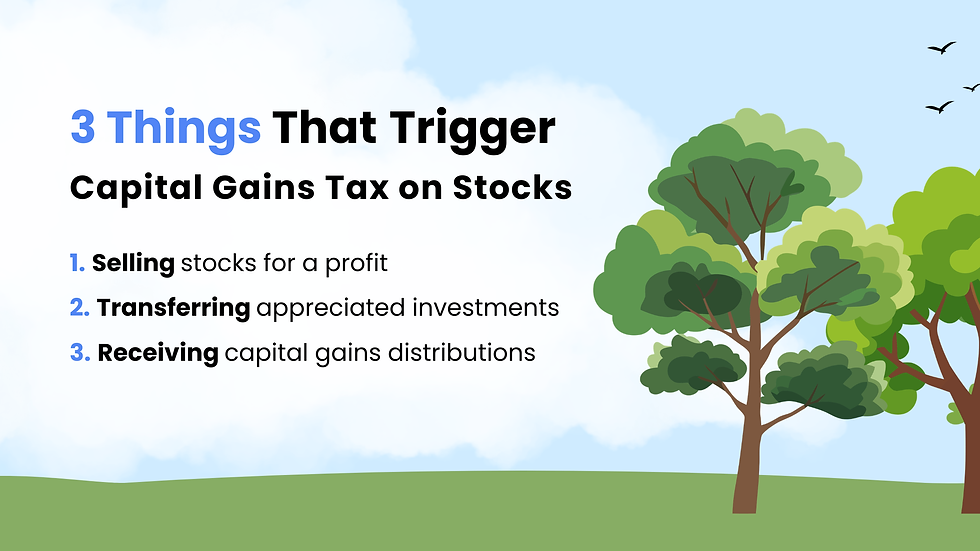
What Actually Triggers Capital Gains Tax on Stocks?
Many investors think taxes only apply when they withdraw cash, but there are other actions that can trigger capital gains tax. Let’s go over the main activities that can trigger capital gains tax on stocks.
Selling Stocks for a Profit
Selling appreciated stocks is the most common capital gains tax trigger.
If you sell shares for more than you originally paid, the profit may create a taxable capital gain. For example, if you bought shares for $100k and later sold them for $1M, the $900k gain may be taxable. The amount of tax depends on your country, account type, income level, and holding period.
Transferring Appreciated Investments
Moving investments between accounts can sometimes trigger taxes.
Many investors assume transfers are tax-free, but that isn't always the case. In Canada, transferring appreciated investments from a non-registered account into a TFSA or RRSP may trigger a deemed disposition. The IRS may also treat certain transfers as taxable events.
Receiving Capital Gains Distributions
Mutual funds and exchange-traded funds (ETFs) may generate capital gains and distribute these out to investors each year.
You may owe taxes even if you did not personally sell the investment. This commonly happens in taxable brokerage accounts.
4 Key Strategies Investors Use to Lower Capital Gains Tax
Investors who plan strategically may have more control over when and how capital gains taxes apply.
Your goal should be to reduce unnecessary taxes while keeping your investments aligned with your long-term goals. For Americans living in Canada, these strategies often require both Canadian and US tax review before making changes.
If you have any cross-border ties, make sure you speak with an excellent cross-border advisor and accountant before executing any of these strategies.
1. Timing Your Stock Sale to Lower Your Tax Bill
In the United States, stocks held longer than one year usually qualify for lower long-term capital gains tax rates. Short-term gains are often taxed at higher ordinary income tax rates. Some investors also wait to sell appreciated stocks during lower-income years, such as early retirement, a career transition, or a business slowdown.
In Canada, 50% of a capital gain is generally taxable regardless of the holding period. However, timing still matters because selling during a lower-income year may reduce the overall tax rate applied to the gain.
2. Tax-Loss Harvesting to Offset Capital Gains
Investment losses may help reduce taxes on profitable investments.
Tax-loss harvesting involves selling investments with losses to offset capital gains. For example, if an investor realizes a $200,000 capital gain but also sells another investment with a $50,000 capital loss, the net capital gain is reduced to $150,000.
Investors need to be careful with wash sale rules in the United States and superficial loss rules in Canada. These rules may deny the tax loss if the investor buys back the same or substantially identical investment too quickly. Many investors accidentally trigger these rules without realizing it.
3. Donating Appreciated Stock to Charity
Instead of selling shares or donating cash, some investors donate publicly traded securities that have grown significantly in value to a registered charity.
In many cases, this strategy helps investors avoid capital gains on the donated shares while also generating a charitable tax deduction or credit. This approach often works well for investors with concentrated stock positions or large unrealized gains. It can also help families support causes they care about in a more tax-efficient way.
Some investors use Donor-Advised Funds (DAFs).
A DAF allows an investor to make a charitable contribution, receive the available tax benefit, and recommend grants to charities over time. This can be useful for investors who experience a large liquidity event, such as the sale of a business or a highly appreciated stock position, but want to distribute charitable gifts gradually.
However, Canadians and Americans should not assume DAF rules are the same in both countries.
US-based DAFs generally provide tax benefits for US taxpayers, while Canadian DAFs are designed for Canadian taxpayers. Cross-border families often need additional planning because a donation to a DAF in one country may not generate the same tax benefits in the other. Before making a large charitable gift, Americans living in Canada should review the strategy with a cross-border financial advisor and accountant to avoid unexpected tax consequences.
4. Exchange Funds
In the US, exchange funds help some investors diversify concentrated stock positions without an immediate taxable sale.
These structures pool together concentrated stock holdings from multiple investors. In exchange, each investor receives ownership in a diversified portfolio rather than a single stock position. Because the original shares are exchanged instead of sold outright, immediate capital gains taxes may be deferred.
Exchange funds are often used by investors with large stock positions.
In Canada, investors with a substantial, concentrated stock position may use Purpose Investments' in-kind exchange to transfer shares of a single publicly traded stock into a Purpose-managed fund or structured investment solution.

Common Questions
How do I avoid paying capital gains tax on stocks?
You usually cannot completely avoid capital gains tax on stocks, but you may reduce it with careful planning. Investors often use RRSPs, TFSAs, IRAs, tax-loss harvesting, charitable giving, and long-term holding strategies. These approaches may lower your tax burden and help you keep more of your investment growth over time.
How can I avoid paying capital gains tax in Canada?
Canadian investors often reduce taxes by using TFSAs, RRSPs, and capital losses. Some investors also donate appreciated shares to charity. In certain cases, donating securities may create a charitable donation tax credit while avoiding capital gains tax on the donated investment.
Homeowners may also qualify for the principal residence exemption, which can eliminate capital gains tax on the sale of a qualifying principal residence.
Does your taxable income affect how much capital gains tax you pay?
Yes. In both Canada and the United States, your taxable income can affect how much tax you pay on investment gains. In Canada, taxable capital gains are added to your income and subject to tax at your marginal tax rate. Higher income often leads to higher taxes on investment gains.
In the United States, your income helps determine which long-term capital gains tax bracket applies. Investors with higher incomes may also be subject to the Net Investment Income Tax, increasing the total tax owed on investment gains.
How can I defer capital gains tax in Canada?
Canadian investors may defer taxes by holding investments in RRSPs or by using structured planning strategies, such as installment sales, capital gains reserves, or in-kind exchange strategies, before selling appreciated assets. Some business owners may also qualify for the lifetime capital gains exemption on eligible small-business shares, although this exemption does not apply to publicly traded stocks.
How does capital gains tax deferral work?
Capital gains tax deferral works by delaying the recognition of a taxable gain. Some strategies allow investors to spread gains across multiple years or postpone a sale entirely. Investors often use this approach to better manage cash flow.
How does fair market value affect capital gains tax on stocks?
In Canada, capital gains are generally calculated by subtracting your adjusted cost base and any selling costs from the fair market value of the investment at the time of sale or transfer. Fair market value is the price at which an investment could reasonably be sold in the open market on a specific date. Selling costs may include brokerage commissions and transaction fees. The Canada Revenue Agency (CRA) may review valuations closely, especially during gifts, transfers, or transactions involving family members.
Can you transfer stocks to a spouse or common-law partner to avoid capital gains tax?
In Canada, you can generally transfer stocks to a spouse or common-law partner at their original cost using a spousal rollover. This means the transfer usually does not trigger an immediate capital gain. However, the tax is deferred, not eliminated.
In addition, Canada has attribution rules under Canada's Income Tax Act that may still tax investment income back to the original owner. If the transferred investments later generate dividends, interest, or capital gains, some or all of that income may still be taxed to the original owner.
Cross-border families should be especially careful because transfers between spouses can have different tax consequences in Canada and the United States.
Are stocks considered capital property for tax purposes?
Yes. In most cases, stocks are treated as capital property for tax purposes. This means profits are usually taxed as capital gains instead of regular business income. Investors may also use unused net capital losses to offset taxable capital gains realized in future years.
Final Thoughts
Most investors cannot completely avoid capital gains tax. However, they can often reduce or defer it with proper planning.
In Canada, common strategies to avoid or reduce capital gains tax on stocks include using TFSAs, RRSPs, capital losses, charitable giving, and, in some cases, in-kind exchange strategies. In the United States, investors may use retirement accounts, tax-loss harvesting, charitable giving, and exchange funds.
For Americans and dual citizens living in Canada, tax planning requires special attention. A strategy that works well in one country may create unexpected tax consequences in the other.
Before selling appreciated investments, review your account structure, tax situation, and long-term goals. For concentrated stock positions and cross-border families, working with a portfolio manager, an accountant, and an estate planning professional can help reduce costly mistakes.
Next Steps
If you’re a Canadian resident or are planning on moving to Canada or the US and need assistance with moving and optimizing your investments, estate planning, wealth management and portfolio management, please get in touch. At SWAN Wealth, we specialize in Canadian financial planning, cross-border financial planning and cross-border wealth management.
Read More
If you’re planning a cross-border move, these articles and guides will help simplify your move and ensure everything is covered.
About the Authors
JOHN WOODFIELD
John Woodfield is a Financial Management Advisor (FMA), a Chartered Investment Manager (CIM), and a Certified Financial Planner (CFP), and in 2007 was inducted as a fellow of the Canadian Securities Institute (FCSI). As a portfolio manager and CFP®, he works with clients across Canada. John Woodfield’s clients are families, individuals and business owners who understand the importance of comprehensive wealth and investment plans driven by the lifestyle they want to lead.
TIFFANY WOODFIELD
Tiffany Woodfield is a Portfolio Manager licensed in Canada and the USA, a Chartered Investment Manager (CIM), a Chartered Retirement Planning Counselor (CRPC), a Trust and Estate Practitioner (TEP) and the co-founder of SWAN Wealth Management, along with her husband, John Woodfield. Tiffany advises clients who live in Canada and the United States and want to simplify their cross-border financial plan, move their assets across the border, and optimize their investments to minimize their tax burden. Together, Tiffany and John Woodfield help their clients simplify their cross-border finances and create long-term revenue streams that will keep their assets safe whether they live in Canada or the U.S.
Schedule a Call
Schedule a 15-minute introductory call with SWAN Wealth Management.


